Of late I have longed to get “back to normal.” It doesn’t matter all that much that my sense of normalcy is far from, well, the norm. The life of a pastor is anything but normal to begin with but when you add a huge transition into the mix everything is up for grabs.
In the last month we moved from Charlottesville, VA to St. Louis, MO. We tried to prepare. We tried to imagine ourselves in a new church, new schools, a new community and city. We made plans and made a budget. Then life set in and, well, like Robert Burns wrote, “the best laid schemes of mice and men go oft awry.” The result has been, as my friend Bob Burns would say, we are living in ambiguity.
We left VA not knowing exactly where we were going to live. That’s right. The five of us, plus Cash – our dog – packed and loaded up and drove 14 hours in a day to St. Louis, MO. We had only a slight notion of where we were going to live. That isn’t something we planned – believe me. Rather, it was something that developed. We planned for a smooth and easy transition. We made plans for a place to lay down each night, a place for meals, a place for pots and pans, and somewhere for dust bunnies to collect. We planned to leave one hearth for another. That wasn’t to be – despite our best-laid schemes.
We knew (know) that Jesus had provided jobs for us in St. Louis but we were unsure of how He was going to provide a place for us to live. Nothing was on paper – nothing was solid – all we had was a one week reservation at a Residence Inn. We didn’t know where we were going to go beyond the first week. We didn’t know if we would find a house to buy or a place to rent. God did.
Since arriving the last week of June we have seen God’s hand at work. He has provided places for us to stay – even the dog. A number of families have opened up their homes to us – inviting our family to stay in their homes, hosting us for dinner, inviting us for a swim. We are grateful for the way that God has provided. He has even opened up a door for us to buy a home (we close- God willing on July 24th – thank you David Klotz!).
The folks in our new community have been God’s source of wonder amid the chaos of a less than smooth transition. It is an experience that only comes from stepping into things the way that God wants us to. Even in the midst of chaos God’s wonder prevails. BUT, do not get the impression that we are just sitting back relaxing in God’s goodness. No. No. Not even close.
If you want to see what life is like for our family you need only flip into the Old Testament stories of Abraham and Moses. God called those men – along with the families and tribes they led – to step into ambiguity. Oh – God provided wonder amid the chaos – but the people grumbled, complained, fought, and chafed in the midst of uncertainty. Yet, God was faithfully putting together His plan, providing for them and establishing hope and salvation through Christ. But the people blew it often – God never did.
That actually captures more of our story over the last few weeks. Yes, we were willing to step into ambiguity – willing to trust Jesus as He led our family. Yes, we’ve been blessed by the ways in which God has used His people to provide for us. No, we haven’t been these super saintly folks who have not been affected by the unknown and the stress of transition. We’ve bickered with each other. We’ve grown weary with waiting and our prayers have had the sound of lament. We’ve lost our cool with our kids and they with each other and us. We have blown it often but God has not.
And yet even in our failures – our very real humanness – we have seen God’s wonder amid the chaos and something else has emerged. It is something I think the people with Abraham and Moses experienced as well. We’ve found ourselves more aware of our deep need and longing for ordinary days of home.
Ordinary days of home are the sort of days that we often complain about– days in which we have to make meals and do laundry, pull weeds or rake leaves, tend to homework and bills. I have found myself daydreaming about planting a garden, washing dishes, cooking, painting walls, and welcoming friends for meals. Sometimes God, for whatever reason, calls us to step out of those ordinary days into ambiguity. If you walk in that long enough while you will experience God’s wonder amid the chaos, you may experience a longing for ordinary days and thankfulness when they return.
There is much that can be said for the ways in which those ordinary tasks are an extension of what it means to give and receive love, to build into the lives of children, to strengthen a marriage, and the joy of hospitality. Granted, in our family ordinary tasks are often the places where we hear and feel the loudest grumbles. However, taken away, the ordinary tasks of home are sought out because they are as much a part of the relational components of home as rest. Kate Harris, Executive Director for The Washington Institute, wrote
By coming to see my ordinary tasks in light of their relational nature and their wonderful, purposeful inefficiency, I come to see what Soren Kierkegaard means when he writes, “The love of repetition is in truth the only happy love.” What is more, I can begin to think afresh about the simple, mundane, but purposeful work God calls me to pursue for the care of myself and my family day by day. Indeed, the Incarnation itself shows us how intimately familiar God is with our daily needs, deeming the faithful care of a loving mother and father sufficient to provide all of the necessary, bodily care and nurture for His only son while on earth.
Ambiguity has given our family something that we may not otherwise have ever known: a chance to see God’s wonder amid chaos and an awareness of the significance of ordinary days of home. I think Jesus understands that. In the New Testament (Matthew 8 and Luke 9) Jesus said, “Foxes have holes, and birds of the air have nests, but the Son of Man has nowhere to lay his head.” That text brings great comfort because it reminds me of the cost of following Jesus. Following Jesus means stepping into ambiguity, finding our peace in the way God provides, being aware of our constant need for God’s Spirit to help us, and joy in the most ordinary of days of home. It is not easy but it is filled with wonder, hope, and good.
For the last few months my family and I have walked through a pretty difficult time. I’ve hesitated to write about it here – mostly because I’ve been processing all that’s happened – and frankly I didn’t want to process it publicly. The bottom line is that I was laid off in February mainly due budget issues.
The good thing is that I was preparing to leave Trinity. For some time now I’ve realized that the Lord was leading us to pursue a new pastoral call. However, being laid off was not in my plan – it was in God’s. I’d have to say – even though it made sense – it was still very, very difficult. I will not go into the reasons why it was so difficult. I will say that we’ve seen God’s hand at work at every turn. We can honestly, faithfully and confidently say that God is good and that He does provide.
One way that was clear is that Trinity’s Session was very good to my family and gave us a heads up and salary from February to August. They also freed me up to work on my dissertation and to look for a new job. A lot of the elders have come alongside of our family, prayed for us and did their best to encourage us. That has been truly good.
Another way that God provides is that He was preparing our family for this moment as many as four years ago. That was when I started my DMin at Covenant. On my first trip to Covenant I almost immediately fell in love with St. Louis. I can say that without reservation. God also introduced me to Bob Burns – who at the time was over the DMin at Covenant. Now Bob is the Head of Staff at Central Presbyterian. Bob and I became friends – and now – Bob, along with Dan Doriani (and the Session), is my new boss.
That’s right – this week the session at Central Presbyterian in St. Louis, MO extended a call (Presbyterian speak for job offer) and I heartily accepted it. I will be the Pastor of Community Development. What’s more – Central has a school – a great school – and they were looking for a 2nd grade teacher…Sherry applied and next year she’ll be teaching 2nd grade!!! Yes the Lord does provide – but not only with jobs – but with wisdom – much-needed wisdom.
Packing Up Our Family
In June our family will be packing up and moving to St. Louis. But packing up – this go around – isn’t just about boxes and a new job. It is about a time of huge transition for all three of our sons – new schools, new community, new church – right at the beginning of their adolescent years. But God is faithful – and He has provided for us. He’s put people in our lives to help us to be aware, even vigilant when it comes to our sons.
When we moved to Charlottesville six years ago our kids were a lot younger. Now they are 13, 12 and 6 (soon to be 7). While our 7-year-old is pretty easy-going about the move, Charlottesville has been the only home he’s really ever known (he was born in AL). But our older two have lived most of their childhood here – and this move is something that will mark them. They really liked their school, their friends, the youth group at Trinity. Now they have to walk away from all that for something new.
A lot of folks in St. Louis and in Charlottesville have asked how our sons are taking the news of a move. I’m glad they have because I think I could honestly overlook their emotions in the hustle to get going. Truth be told I could overlook Sherry’s emotions as well. Even though we’ve prepared for the possibility of a move for some time it has now become a reality. We are excited and thankful and I can’t wait to get to St. Louis – to show my family around a city that I love and I church that I am thrilled to be called to serve. However, it is in that excitement that I could overlook or even be annoyed by my family’s slow transition to embrace what I’ve long embraced. That would be a terrible failure on my part.
So even while I’m thrilled – I think I’m going to have to take things slowly and allow my family to take things in stride. I’m confident that they will come to love the city and the church like I do (at least I’m hoping). But getting a heads up from friends has been helpful already. In fact, today a friend of mine who has moved many times in the last few years sent me an email with some much-needed wisdom.
He wrote, “As one who has moved more than is optimal in the past…my encouragement to you and Sherry is an old one: even if you are going to a great place and your gifts and inclinations are well-suited to your new position….and even if the place to which you are moving has many familiar faces…it can easily take 3 years to begin to feel like home. So give it some time. And keep a close eye and ear on your sons. Ours are just now talking through some of the difficulties they experienced when we moved…they were 12 and 14 at the time…sound familiar???”
Yes – this is wise and I’m very grateful. I hope that I’m able to do this. It is amazing to me how God provides and the ways in which He does so. So – even though (as a friend pointed out to me this morning) the “The lines have fallen for me in pleasant places; indeed, I have a beautiful inheritance (Psalm 16:6 ESV)” I would be wise to allow my family to come to the place where they can see that as well – with God’s help.
With that said – I know that God is providing for our family – so I’d like to ask something of you. Would you be willing to toss some ideas our way? If you have moved with teenagers – or if you moved when you were a teenager – can you toss some advice our way? I’d be very, very grateful – and – my family may be grateful as well.
Recently I’ve found myself reading a lot of poetry. I like poetry – well – I like what I like. Sometimes I read poems and I think – what in the world are they talking about. Not today – today I came across a poem that I totally get and, just as important, I like it. So, seeing as how I like to share things I like – I thought I’d pass this poem on to folks.
It is called The American in Me and it came to me from another blog I get updates from called Curator. I like this poem because it reminds me of folks I love – because I’m related to them or because I have been fortunate to know some really good folks. I also like it because it sort of reminds me of me – or part of me – or at least some part of me that I once knew and I’m not the least bit embarrassed or ashamed of. You can find the poem below – or just click here: http://www.curatormagazine.com/joshua-cave/the-american-in-me/
Up until a few years ago I was blissfully ignorant, fat and happy. Now, I’m just fat and not all that happy about it. Back then – back when I used to pull into a drive-thru with my wife and kids, order a super-sized sack of “Lord knows what” – I didn’t think so much about family farms or industrialization, community, rain, bugs or the chemicals used to annihilate them. My yard was something to mulch, mow, or rake not something I could use to put food on my table. Then some well-meaning soul introduced me to Wendell Berry: the Kentucky farmer, poet, and author. That person should have warned me.
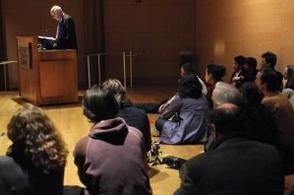
I had just started reading some of Berry’s fiction when I heard he was coming to Charlottesville to give a lecture. I should qualify this statement – I’m not sure Berry’s books are fiction. Fiction shouldn’t have the sort of effect that Berry’s stuff has. Besides poetry and essays, he writes about the people, farms, in a fictional community in rural Kentucky called Port William.
While reading his books, Jaber Crow and Andy Catlett, I found myself longing for the sort of community that only my grandparents fully knew. It wasn’t like I wanted to go back to the “good ole days”. No. The sense of community that Berry gives is bigger than that. It is the reality that our lives are connected to each other and the things that we do or do not do have an impact – on not just us. In fact, he is quoted as saying we should not have a “split between what we think and what we do.” If we say we care about folks then there ought to be something to show for it. Therein is a sense of community (shalom perhaps).
I had just started to realize that Mr. Berry was writing more than “just” stories when he came to Charlottesville to give a lecture. I’ve sat through a lot of lectures in my day and, quite frankly, I’m not very good at it. But for some reason, I wanted to attend this one.
That night he talked about farms (large and the family farm), politics, money and the way they connect to how food is brought to the table. Many of the ways food comes to our tables actually brings harm to communities. At one point he said, “Simple solutions will always lead to complex problems, surprising simple minds.”
He was humble, gentle and kind. It was not unlike having a wise friend over for coffee; except at the end of the conversation you suddenly find that he had completely rearranged your house. I went into that lecture one guy and came out another – fat but not happy and ignorant. I’m not sure how it happened; however, I’m pretty sure that Berry used some sort of Jedi mind trick.
All I remember is that Berry said that people ought to know and care where their food comes. He also said they ought to participate in getting it to the table. At some point that evening I found myself mumbling, “I should know where my food comes from.” I left that evening with a copy Bringing It to the Table: On Farming and Foodand an overwhelming urge to plunge a shovel into dirt and plant stuff. When I got home I announced to my family that we were going to change our lives and grow our own food.
Everything was going to change. It would require us to change the way we buy food. No longer would we eat fast food – except for Chick-Fil-A (because their food is goodish for you and they do good in the world – the others are the evil empire). We would also need to change the way we shop for food – trying to go local but being aware of how our food gets here. It also meant we would use some of our yard for a garden. My family looked at me like I had lost my mind. Sherry just smiled – she’s been living with crazy for almost twenty years.
But I was serious. I worked on a farm to help pay my way through college. I wasn’t naïve about the hard work. But I had forgotten was that I am twenty-plus years older and I live in the suburbs. We couldn’t have chickens or a cow and we really didn’t have too much room for a garden. Nevertheless, I was committed. After all, Mr. Berry said we should know where our food comes from and we ought to help get it.
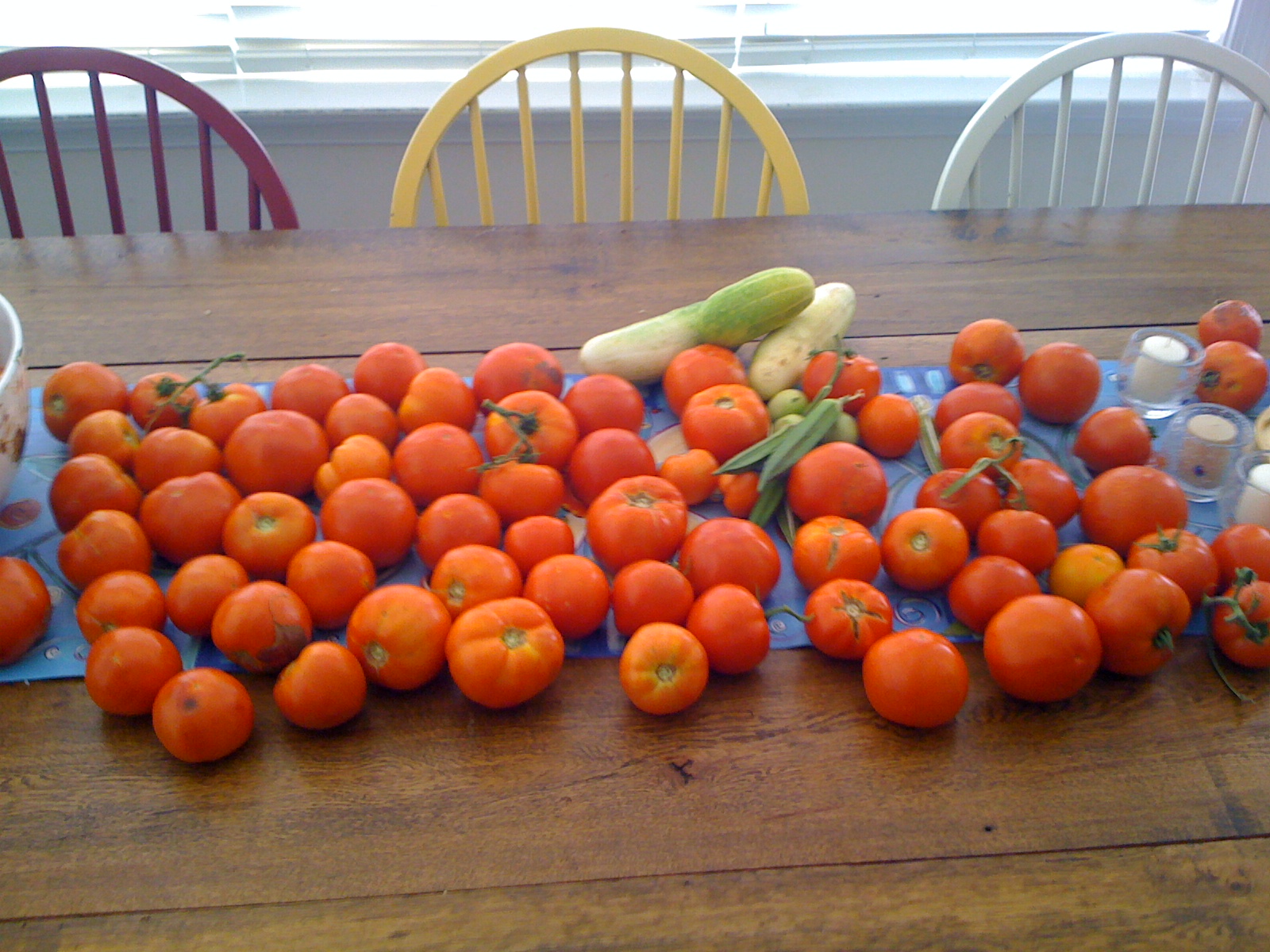
Two days later I found myself behind a tiller. I had prepared a place that would get just the right amount of sun. I had a heap of organic soil that would soon be home to our food: tomatoes, peas, green beans, cucumbers, okra, peppers, watermelon, basil and thyme, bell peppers and broccoli. Sherry looked at me with the sort of “Clearly you do not know what you are doing but I love this crazy side of you.”
That tiller nearly beat me to death. It pulverized me more than the soil. At some point I was reminded of the agreement I made with the bulging discs in my neck and lower back about manual labor. I was not to do it. Nevertheless, I kept on mixing, tilling and preparing the soil.
Once I got the soil ready I started laying out the neat rows. My youngest son and I dug little holes, dropped in a few seeds here and there, carefully placing them. We did this for a while and then I tried to stand up. I had to have my four-year-old son help me and I groaned the loudest old man grunt ever. He looked at me and said, “You okay Daddy?” Of course I am. I’m participating in getting food on our table.
The worst part was the day was pretty hot; there was a huge sun in the sky. It wasn’t that the heat bothered me in fact I didn’t really notice. That was unfortunate because I forgot to wear a hat. Now for most folks that’s no big deal. For bald-guys that’s a huge deal. I scorched the top of my head. Let me add, it hurt when I blinked.
That evening with everything tucked into their nice tight little rows I stood with my family looking with hope on our little garden. One of my neighbors joined us. My youngest son began to tell him all that he had planted. At one point my neighbor said, “What are you going to do about all the squirrels and deer?” I, uh, hadn’t thought of that.
The next day I was out there again with wildlife netting, doing all I could to protect the food I was determined to bring on our table. At one point I was stooped, laboring over a stubborn old root when I thought, “Why in the hell am I doing this? Who is Wendell Berry and why can’t I stand up straight?”
Then, from my stooped position, I saw my family working alongside one another carefully putting netting around the fencing. They were talking and laughing and enjoying themselves. My youngest son was going over each area that he had planted the day before, patting the soil as a way to encourage things to grow (and he doesn’t like veggies). As we worked, side-by-side, helping each other, to get food to our table, we started planning a menu and who we could share the bounty.
Something happened to my family that never happened in a grocery store or even farmers market. We were participating in bringing food to our table but we were also focused on the fact that we wanted to share what we were growing. That subject came up naturally and organically. There was a sense of community that had come up even before the first green bean shoot.
Something else happened. That evening, with the wildlife netting in place, we stood and looked at our frail but hopeful garden. We realized how vulnerable and dependent each one of these plants was. They were susceptible to everything and it was going to be up to my family and I to protect and raise them. After all, one day these seeds and tomato plants would bear fruit and grace our table and bless the lives of people that we love. That’s when concern grew larger.
I had only thought as far as the planting and the harvest. I had not realized how much care would need to go into bringing this food to the table. Nor was I ready for how much I would care. Standing at the produce section of my local store I had not given much thought to how they were grown. I made a lot of assumptions.
But standing above my own plants I realized that the fruit of our labors was going to actually be food for my wife, my sons, our neighbors and friends. Bugs and vermin are real possibilities but would I put just anything on the plants to protect them? What damage could it do to my family? The soil? There was no way I was going to put anything on these plants that could cause them harm.
The things that Berry had said began to sink in even further. The sense of community extended beyond just giving folks good things to eat. It extended into the how we are getting things to the table. How are food gets to the table matters. It matters a lot.
Day that our first tomato was ready to be picked was a memorable occasion. We were grateful in ways we had never been grateful before – and amazed. The labor of our family, the care that we had put into the garden was rewarded and our care was rewarded with the “the fullest pleasure – pleasure, that” did not in any way “depend on ignorance,” as Berry wrote in Bringing it to the Table.
Perhaps you’ve never been introduced to Berry; if that is the case, do not delay – go and get acquainted with him as quickly as possible. It is safe to say that Wendell Berry has had a tremendous impact on me. This year, for reasons beyond my control, I haven’t been able to put in a garden. I miss it. I miss the hard work as well as knowing where my food comes from. I miss participating in getting food to our table. I miss the way our family worked together to care and cultivate. I’ll also miss the fruit of our labors as much as sharing it. And yet – thanks to Berry – I am no longer “fat and happy” and blissfully ignorant and I do not miss that.
Here is a poem from Berry I came across the other day – can’t remember where:
The Future
For God’s sake, be done
with this jabber of “a better world.”
What blasphemy! No “futuristic”
twit or child thereof ever
in embodied light will see
a better world than this. Do something! Go cut the weeds
beside the oblivious road. Pick up
the cans and bottles, old tires,
and dead predictions. No future
can be stuffed into this presence
except by being dead. The day is
clear and bright, and overhead
the sun not yet half finished
with his daily praise.
Last week the school where my sons attend held their first poetry festival. I must say that I was impressed. Students from Pre-K (that’s four-year olds) thru sixth grade recited poems of varying length. They did an incredible job. What stood out to me was how well the students had memorized poetry (including the Pre-K class) and that they stood in front of tons of folks and recited it. It was great!
That festival – and festivals like that – are important. Not just because it exposes children to poetry (that can be good or bad) nor just because it connects them to the arts (although that’s significant). It is important because it can give shape to their moral imagination, which hopefully will move them towards wisdom.
I haven’t heard that sort of language – especially at it relates to children – all that much. I have heard a lot about character formation and I’ve heard a lot about preparing kids academically for their future. But what about wisdom (can you separate character and wisdom? Is it wise to separate knowledge and wisdom?) What is shaping the way a child makes decisions? How are they becoming not only smarter but wiser? Where are they learning to navigate the gray areas of their own hearts and the hearts of others?
Vigen Guroian’s Tending the Heart of Virtue: How Classic Stories Awaken a Child’s Moral Imagination suggests classic stories go a long way to shape a child’s imagination and move them toward wisdom. He cites the original classics (do not confuse with the Disney-ed versions) like Pinocchio by Carlo Collodi and The Little Mermaid by Hans Christian Andersen.
The “real” stories do not hide the fact that life is tough and our actions have consequences. Not everything ends in “happily ever after.” These stories make us aware of good and evil, right and wrong, and the fact that human beings and life in general can be gray and not merely black and white. In these stories the reader becomes part of the action because they are so compelling and honest about what it means to be a real person. Thus they awaken a sense and desire to move toward the good (especially when the main character is not so inclined or acting – well – foolish).
That thought jumped out at me during the poetry festival. So many of the poems that these children had learned moved toward wisdom. They used images and story, carefully crafted metaphor to offer insights into life. Not all the poems did that – but a lot of them did (some where just great, fun poems from Shel Silverstein). But one poem that three young women recited at the festival has stayed with me. It is a somewhat familiar poem. It is a poem called “Three Gates.”
THREE GATES
If you are tempted to reveal
A tale to you someone has told
About another, make it pass,
Before you speak, three gates of gold
These narrow gates: First “Is it true?”
Then, “Is it needful?”
In your mind give truthful answer,
And the next is last and narrowest,
“Is it kind?”
And if to reach your lips at last
It passes through these gateways three,
Then you may tell the tale, nor fear
What the result of speech may be.
From the Arabian (Tapestries of Life)
It is easy to see how this poem sparks the imagination and could move a child (or an adult) toward wisdom. My hope as I sat there and listened to these students was that the words they were saying – ones they had memorized – would find their way into their imagination – that they would move beyond words on a page – and move them toward wisdom.
Perhaps there is no better source of poems to give shape to moral imagination and move people toward wisdom than The Psalms. Tucked within that book of verse are poems of all kinds and various genres. The great thing about a lot of the poems is that we know a lot about the poet: David, Israel’s great king. Many of his poems tell the stories of his life in verse and, the best part, David is not the hero of his poetry.
That’s why they are perfect for giving shape and moving a child toward wisdom – because they point to the fact that David was like every other human being: broken and in need of help that only God could give. How can a poem like Psalm 3:1-4 not give shape to a child’s imagination – how could it not move a person toward wisdom?
The great hero of this poem – the poet tells us – is God. The poet cried out and God answered him. One great thing about this poem – as it shapes the imagination is that it points out that God delivers – He has done that once and for all in Christ. Think of how poems like this – given to memory – can give shape to moral imagination and move a child toward wisdom.
Make no mistake: if He rose at all
it was as His body;
if the cells’ dissolution did not reverse, the molecules
reknit, the amino acids rekindle,
the Church will fall.
It was not as the flowers,
each soft Spring recurrent;
it was not as His Spirit in the mouths and fuddled
eyes of the eleven apostles;
it was as His flesh: ours.
The same hinged thumbs and toes,
the same valved heart
that–pierced–died, withered, paused, and then
regathered out of enduring Might
new strength to enclose.
Let us not mock God with metaphor,
analogy, sidestepping, transcendence;
making of the event a parable, a sign painted in the
faded credulity of earlier ages:
let us walk through the door.
The stone is rolled back, not papier-mache,
not a stone in a story,
but the vast rock of materiality that in the slow
grinding of time will eclipse for each of us
the wide light of day.
And if we will have an angel at the tomb,
make it a real angel,
weighty with Max Planck’s quanta, vivid with hair,
opaque in the dawn light, robed in real linen
spun on a definite loom.
Let us not seek to make it less monstrous,
for our own convenience, our own sense of beauty,
lest, awakened in one unthinkable hour, we are
embarrassed by the miracle,
and crushed by remonstrance.
For $25 you can buy a pound of cotton from North Carolina – The Cottonman. I think that’s awesome and I’m thinking of buying some but not just because I like cotton. Rather, it is because the first time I saw cotton fields they captured my imagination and led to an experience that I’m not likely to forget.
I was driving in rural Alabama. It was the time of the cotton harvest. It was a beautiful day – which is mostly the case in the Deep South (even when it is so hot it feels like someone wrapped you in a wool blanket and poured hot water over it). The sun was out – but there was something white blowing across the road. I had seen white stuff blowing across the road before – but that was when it was gray and cold and the sky full of clouds. This wasn’t snow.
It was cotton. Some bits and pieces pulled free from huge cotton bundles on trailers as trucks took them down the road. Other bits and pieces blew from the once white fields made mostly brown/black stalks by enormous, green harvesters. The fields were a jumble of sticks and dirt and bits of left behind cotton.
Harvesting Cotton John-Deere-7760
Cotton and cotton fields have long-held a place in my imagination. As a little boy I was drawn to Civil War history, to Mark Twain, and pretty much anything to do with the south, her history and culture. Cotton and plantations were always somewhere in the background of my imagination. The reason, I think, was quite simple. I could not make sense of it.
What I mean is that I have always loved the south but as young boy I couldn’t make sense of the painful, sad parts of her history – which was most often represented in my minds eye by cotton fields. I can close my eyes and see them – the white fields – plucked clean now by machines – where once they were filled with men, women and children – stooping, pulling, and filling sacks. It is hard not to connect the full white fields to days when Americans “lawfully” enslaved people. In the land born of liberty and freedom there was slavery, injustice, and oppression; all for money. That painful, sad history extended beyond the fields, entering into city ordinances, state laws, churches, and schools and my imagination.
Black people picking cotton while their white overseer rides a horse (Photographer unknown, ca. 1895)
It took the law of love to bring change. It was encouraged by pastors and extended by children, some as young as six. The children went from churches – marching to pray, singing hymns and spirituals as they went, all the while suffering abuse and jail from their fire-hose and dog wielding oppressors. This history is not lost on me as a Christian, a student of history, and a southerner who hates racism while loving the south (and one who for love of union and abolition is glad “we” lost the war).
And yet – now the image of cotton fields reaches into my imagination and memory reminding me that even out of pain and sadness there is hope. God’s children are not without suffering. We are not without pain and sadness. And yet there is hope – God can bring good out of the worst possible places, out of slavery, out of racism, and out of the cotton fields of Alabama.
My family and I were living in Alabama – a state filled with places that look like a scenes from To Kill a Mockingbird. A friend, Mark, invited me, to attend an unusual gathering of folks. Mark ran a farm of sorts near the campus of Alabama A & M. All the work Mark and others put into raising food was so that poor people could eat. Mark believed that God wanted him to farm (despite not knowing anything about farming) and give the food to the poor. Turns out the Bible supports that notion – and Christians are to care about folks flourishing – it has something to do with shalom.
When all the work was done folks didn’t leave. Instead they started to gather in a large, hanger like building that had once been A&M’s cannery. This was what Mark had invited me to witness; it was an experience I will not easily forget. Folks began to gather at one end of the building, in a close semi-circle. They sat on buckets, chairs, and the concrete floor. An elderly, African-American gentlemen sat down and the shuffle of feet subsided. Mark looked at me with a big smile as the gentlemen began to sing.
I did not know the song. I had never heard it before and at first I thought he was making it up – beautiful, soulful as it was. Then, just as he finished the first chorus – folks around me joined him. They filled the room with their voices, with their songs, and they were tied to the fields painful, sad history.
There was no way for me to know the words to the songs. These were not my songs because these were songs born out of the pain and sadness of slavery, of injustice, of oppression. They were songs born in the fields and tied to the cotton field’s history of pain and sorrow songs BUT not left there. These slave songs were born out of pain but written and sung and passed down with hope that God by His Son and through His Spirit would redeem his people.
What I saw that day was truly one of the most amazing worship services I’ve ever seen. I didn’t know the first song. I could only stand back and listen. Mark couldn’t help smiling at me. “It’s like this every week,” he said.
That worship experience was more than fourteen years ago. I’m not even sure if Mark is still farming – we moved away from AL six years ago. Yet I can close my eyes and just about hear them sing. They sang songs that had been passed down to them by their parents and grandparents, slave songs – which, though born out of something terrible, connected them to the same hope and joy which has lifted God’s people up since Adam. They knew the same God who sets the captives free in the Bible is the same God who set their great grandparents free, set them and their children free from injustice and sets them free in Jesus.
So they sang the same songs their ancestors sang. They sang as the Psalms teach God’s people to sing and to pray; fully, holding nothing back. The Spirit filled their songs, reminding them (and teaching me) that God does bring good from the painful, broken, sad, places of our lives.
If you haven’t spent much time in the Bible you might be surprised to find that it isn’t all “puppy dogs and rainbows.” In fact, it is true to life – telling humanities story and God’s intervention in sometimes graphic terms. Some folks struggle with that aspect but I think it is quite helpful because most folks I know struggle with one thing or another. I don’t have much capacity for the pushers of Pollyanna theology, the “God just wants you to be happy and healthy and rich” – you know the big ego, big stadium, big hair kind of folks. I’m not sure what version of the Bible they are reading – if they are at all.
The Old Testament doesn’t skip over the bad parts. Those slaves songs, like the Scriptures, were passed down from parents to children (Deut 6). They were meant to prepare people for life in a fallen world and point them in a Godward direction. Sometimes I think we do kids a bad turn when, in an effort to protect them, we insulate them from reality. They are bound to have troubles because, until Jesus comes, that’s the way of the world. There are things beyond our control and we’d do better by our kids to prepare them – shape their character and their moral imagination.
The Psalms, in particular, give shape to the way God’s children learn to pray and sing and live. Reading them gives a person the full scope of life. The people who sang and prayed these Psalms had once been slaves in Egypt, and they sang of God’s deliverance. They knew pain and sorrow – a great deal of which was their own fault (which sound familiar to me). They also tasted injustice and hatred – and they cried out to God. Psalm 137 is one of those Psalms; it is written from anguish and heartbreak: “By the waters of Babylon, there we sat down and wept, when we remembered Zion. On the willows there we hung up our lyres. For there our captors required of us songs, and our tormentors, mirth, saying, “Sing us one of the songs of Zion!” How shall we sing the LORD’s song in a foreign land? If I forget you, O Jerusalem, let my right hand forget its skill! Let my tongue stick to the roof of my mouth, if I do not remember you, if I do not set Jerusalem above my highest joy! (Psalm 137:1-6 ESV)”
These were God’s people – they had been carried away in exile. They knew pain and sadness well. Their lives were ripped open. They were mocked, abused, forced to leave their home. They knew hardship and pain in ways that I don’t even want to imagine. But they wrote about it – as prayer to God.
What stands out to me is the fact that this text still remains. It is a painful Psalm to read because of the anguish, the anger, the pain. It was a dark time in the lives of God’s people, a terrible time. And yet, this Psalm, marked this time and it was passed on from one generation to another – down to this very day.
I think I know why – at least I can speculate. The Babylonian Empire hasn’t existed for – well a very long time but God’s people still do. Apparently, God really does love justice and he does keep His saints. I also think what is expressed in this Psalm gives shape to the way God’s people pray and sing. Because sometimes we feel the way they did and because God delivered His people – and still does.
Verses like these giving shape to our hopes by telling us that we are God’s children. We have been adopted by God (and I love adoption); we are His sons and daughters. Of course, our adoption is made possible through Christ – that’s what Paul is trying to tell us – our place is sure in Christ.
But something else gives shape to our hope – its phrase cry Abba or Father. When does a child “cry out” for their dad? In times of pain and trouble, of course. And – since we know we are his sons and daughters we know that we can do that – approach God as Father in the midst of troubles.
But how does we hope a father will respond? Well, in all honesty I don’t alway respond with the sort of kindness and compassion that I should. Sometimes when my sons cry out I’m busy and I don’t want to be bothered. Well – that’s my way but not God’s way.
Children also cry out in moments of joy and surprise. That’s always a good sound – when your kids are glad to see you – when they say, “I love you.” When they thank you for the good things you’ve done for them.
Isn’t this a nagging verse? Is the Bible giving an assurance that things will turn out for good for God’s people? It sure seems so…But isn’t this the hope we long for?
I think it is. Even though we may not understand why it is that we go through things and they may be terrible – in the midst of them we want and need hope that things will work for good. God gives this hope to His children which is part of the way we can persevere. In fact, I believe the story of the Bible is wrapped up in this hope – that Christ by His life, death and resurrection makes new lives out of broken ones (something I can personally attest), sets captives free (and we are captive to something), restores human beings to God, brings peace (shalom) to fractured relationships, and brings light into dark places. The essence of the Biblical story is that God, through Christ, redeems the painful, sad parts of life and makes them good as only God can.
I think this hope has carried God’s people from the time of Adam until now – ultimately God will restore all things and make things right and good. I think it was this hope that shaped the slave songs. Their assurance was bound up in Jesus in ways I could only image. Jesus turned their mourning into gladness – even as they worked those fields. The foundation of their songs wasn’t sorrow, nor self-pity – it was hope, a hope in Christ, a hope that all their suffering and hardship was going to turn out for good. It is a hope that all God’s children can sing about.
I may buy a pound after all…
Links and Resources:
Learn to sing the Psalms: http://psalter.org/
Want to know more about Civil Rights & The Children’s Crusade – Birmingham 1963 http://library.thinkquest.org/ http://www.pbs.org/godinamerica/interviews/clayborne-carson.html http://www.encyclopediaofalabama.org/face/Home.jsp http://www.history.com/topics/civil-rights-movement http://www.pbs.org/wgbh/americanexperience/freedomriders See King’s Letter from Birmingham Jail http://www.africa.upenn.edu/Articles_Gen/Letter_Birmingham.html
Check out the history of Negro Spirituals, Cabin Music and Slave Songs http://www.pbs.org/wgbh/amex/singers/ http://www.negrospirituals.com/news-song/index.htm http://ctl.du.edu/spirituals/ Honey in the Rock: The Ruby Pickens Tartt Collection of Religious Folk Songs By Olivia Solomon, Jack Solomon
On occasion I find things around town that make me laugh a bit. Not long ago I was in the Super Market and came across these two items. I’m not really making fun – okay maybe I am – but I’m just as likely to make the same sort of mistakes…okay maybe not.
My math isn't the greatest but I'm pretty sure this isn't a better deal.The World's Most Expensive Pie...it better be good.
You may think this is strange but I’ve discovered that my love language is cooking. What I mean is that one of the ways that I show my family I love them is through cooking. I love it – and I especially love it when my wife and sons really, really enjoy what I’ve cooked. That is not to say that I’m a great cook – but I want to be and I am trying to learn. What makes this all the more enjoyable is that cooking isn’t so much about me (although I benefit) but about my family.
Last night I stumbled across a new dish that was amazing. One of the best parts is that it combined a marinade that Sherry created a few weeks back with something I did. Perhaps even more importantly it helped to get my youngest son to eat veggies (something he does not care for). So – I thought I’d share – first because I was thrilled with the results and because of that I want to offer it.
Sherry’s Simple Marinade:
A few weeks back Sherry experimented a bit and came up with a very simple marinade – which is amazing on beef and chicken. We’ve tried it on both – grilled the meat – and it has been awesome.
In a large zip lock back “dump,” as Sherry put it, Italian Seasoning, Olive Oil, and Soy Sauce. Then put in either beef or chicken. Zip that bad boy up – shake it around and then place it in the fridge for a few hours. That’s it. I promise you will not be disappointed.
Fajitas
Ingredients:
Strip Steak – (or Chicken): it is important to get good quality meat, well marbled.
Sherry’s Simple Marinade
Red Pepper
Yellow Pepper
Orange Pepper
Garlic (one clove)
Onion (1/2)
Fresh Basil
Salted Butter
Worchester Sauce (thick and thin if you’ve got them)
Sea Salt
Crushed Black Pepper
Grill your Steak:
I love to grill – so I recommend grilling the marinated strip steak (or chicken). Since this is a thin cut of meat be sure to keep an eye on it. Don’t overcook – you do not want this meat to be dry (but you do want to make sure you cook it thoroughly – 165 degrees). I actually cooked my steak the day before and took it from the grill and immediately put it in an airtight container and placed it in the fridge for 24 hours.
Prep the Steak (chicken) Veggies & Stuff
Cut up the peppers into smallish – thin strips.
I cut ½ an onion – I like mine sort of small so they will cook up better
Chop up the garlic clove
Cut up the fresh basil very fine
Cut the steak into long strips – not too thin
Cook it up:
In a large skillet – over medium heat – melt salted butter (I like the flavor butter adds. Yes I know Olive Oil is healthier but we are going for love here). After the butter has melted toss in the veggies, garlic, basil, salt & pepper. Toss that around for a while – let those flavors mingle. Add a little of the Worchester sauce (thick if you’ve got it). When those things have cooked up add the steak (or chicken). Add a little more Worchester sauce if you want. Make sure that you mix the meat into the other ingredients. Cover it for a while and let it sit on low heat.
Serve it up:
Warm up some tortillas. Place rice and beans in the middle of the tortilla and add a little cheese – then add the fajita mix on top. Top it with sour cream if you have a mind to – or a bit of hot sauce or salsa. Serve it up to your family for an awesome meal!
Not long ago I sat at my favorite coffee shop here in Charlottesville, VA. Across with me sat a man I have come to respect and appreciate – largely due to a book he authored (which is given some shape to the way I parent). In the course of our conversation he said, “You know – these are anxious times.” I listened to him as he unpacked that statement. He was right – these are anxious times.
So why would Jesus say something like, “do not be anxious”?
Well – like I said before – I don’t think he’s trying to be cruel or ironic. In fact, I’m fairly certain that Jesus understood people – very, very well. I think, in fact, that if Jesus is saying don’t be anxious then he’s probably got a way figured out for folks not to be anxious. It may be worth thinking about. Perhaps Jesus wants to give shape to our image of a good life – and what is really essential for us to know.
So – if Smith is right – and I think he may be – then why are these anxious times? Why are folks so anxious about everything? Why are children suffering from anxiety disorders – more so now than perhaps previous generations? Why are parents anxious about their kids’ future? Why are seniors anxious about their golden years?
Is there a connection between our ultimate love, our desire for what we imagine to be a good life and anxiety?
I think there is. Think about the fact that the average American family is in debt because we bought cars, clothes, homes, went on vacations, went to concerts, or went to university, sent out kids to camps, etc. Why? Most likely because we were pursuing our vision/image of a good life – but now we are anxious about making those payments in a shrinking economy. A lot of folks have less income now than they did and things that seemed like essentials a few years ago are clearly not essential any longer. But the anxiety is probably still very much a reality – each month when the bills come due.
I think Jesus is trying to give shape to our desire – our vision/image of a good life. One of the first things that He says is that “your heavenly Father” knows what you need. That’s a comforting reality – if you understand/believe/ have God as Father. That takes some pressure off – it is not all up to us. God knows what His children need and He provides.
If this is true, and I think it is, how does this impact our anxiety levels? It may impact them a lot – because if we think about it – it means that God is the one who not only supplies our needs but also defines our needs. What I mean is that we will have to start thinking about what is really essential which will impact our desires. That means that our vision/image of a good life may need to change – which probably means that someone else will have to shape our ultimate love.
Perhaps this is why Jesus follows this up by saying, “But seek first the kingdom of God and his righteousness, and all these things will be added to you.”
Is this the cure for anxiety? Is this the vision/image that people, parents, children, students are supposed to have? What does it mean to seek first God’s Kingdom and His righteousness?
What if God’s kingdom and His righteousness were your ultimate love? What if that was what motivated you to get up and get going in the morning? What it the notion of God’s kingdom and His righteousness gave shape to the way you raised your children, spent your money, loved your family, did your work, saved for retirement? What if the vision/image of God’s kingdom and righteousness shaped your desires and your understanding of what was an essential and how those things were going to be provided? Would that be an end to anxiety – would it at least curb it?
Jesus seems to be saying so – especially in the next verse (Matthew 6:34). He says, “Therefore do not be anxious about tomorrow, for tomorrow will be anxious for itself. Sufficient for the day is its own trouble.”
Wouldn’t that be amazing – to be able to put anxiety aside? How different do you think your life would be – if you could really have no anxiety? Well – Jesus says it is possible. But maybe he is wrong. Maybe Jesus got it wrong and we are supposed to live with chronic anxiety.
Or perhaps Jesus is right, and I think He is, and He is trying to give shape to the right vision/image of a good life. Maybe Jesus is right and human beings really are creatures who desire to live out an image of a good life – but that desire/vision/image is supposed to be shaped a vision for God’s Kingdom and Righteousness.
If he is wrong then we seem to know what we are doing; anxiety is part of being human. That doesn’t seem right though. Anxiety seems to be killing us. But we just have to evolve.
But if he is right then perhaps we need to learn what it means to live out this vision/image of God’s kingdom and righteousness. I think it’ll mean learning a lot about what Jesus meant by God’s kingdom and righteousness. At a minimum I think it’ll mean:
That we care about the things that God cares about.
It means that we pursue good –not just for ourselves but also for others.
It means that we look not only for our interests but the interest of others.
It means that the decisions we make about how we spend our time and our money matter beyond ourselves.
It means that our first order of life is about pleasing – not ourselves – not our parents – not our friends – not our teachers – but God –first and foremost.
It means your life matters more than you actually think because it belongs to God’s kingdom and God’s work in the world – your life has eternal significance – what you do in this world matters because it is part of God’s kingdom.
It means our ambitions need to line up with God’s purposes in the world.
It means that for those who are in pursuit of God’s kingdom are in pursuit of a good life – and one where needs are provided…there is no need to be anxious.
It means that our children will be raised with a different view of the world, and people, and God and themselves.
Let me ask you – as you think about what it is that you desire – what is driving you –when you think about how you would define “a good life,” do you give any thought at all to the fact that Jesus calls people to “seek first God’s kingdom and His righteousness?” – is that your first priority when leading your decision making?”
If not perhaps you need to ask yourself a few questions:
Perhaps you need ask if you are part of God’s kingdom and if not why not. The truth is I don’t think you can pursue God’s kingdom and righteousness apart from God. I don’t think you can ignore Christ and just try to be good. I’m pretty certain that if Jesus is the one pointing toward this vision of the world then God intended for people to consider Christ and what He’s saying in the process. I don’t think we get to pick and choose what we like and discard the rest.
If you have put your faith in Christ – trusted Him for salvation and look to Him as your only hope – but you realize that you are not seeking God’s kingdom first – that’s okay – this is a good time for you to pray and ask the Lord Jesus – by His Spirit to help you.
Honestly – even as a pastor – I have to do this all the time because the cares of the world sidetrack me easily…but God is faithful. In my own family I have been guilty of driving my kids to think about their future – not so much because they are part of God’s work in the world – part of God’s kingdom – but as a means to an end – an end toward happiness.
I mean – the vision/image of a good life that I’ve passed on to my sons is one shaped – to some degree – not by God’s kingdom but by, well, perhaps the American Dream. However, I recognize my failure in this. I think life is more than a good education, job, etc. Life isn’t supposed to be all anxiety. I think Jesus is right. I think the right vision is a vision of the kingdom. I want to help my sons have that vision. I want to have that vision of seeking God’s kingdom and righteous – I want to pass that along and not a roll of Tums.
 Of late I have longed to get “back to normal.” It doesn’t matter all that much that my sense of normalcy is far from, well, the norm. The life of a pastor is anything but normal to begin with but when you add a huge transition into the mix everything is up for grabs.
 how He was going to provide a place for us to live. Nothing was on paper – nothing was solid – all we had was a one week reservation at a Residence Inn. We didn’t know where we were going to go beyond the first week. We didn’t know if we would find a house to buy or a place to rent. God did.
 Ordinary days of home are the sort of days that we often complain about– days in which we have to make meals and do laundry, pull weeds or rake leaves, tend to homework and bills. I have found myself daydreaming about planting a garden, washing dishes, cooking, painting walls, and welcoming friends for meals. Sometimes God, for whatever reason, calls us to step out of those ordinary days into ambiguity. If you walk in that long enough while you will experience God’s wonder amid the chaos, you may experience a longing for ordinary days and thankfulness when they return.
























 Mark A Hutton